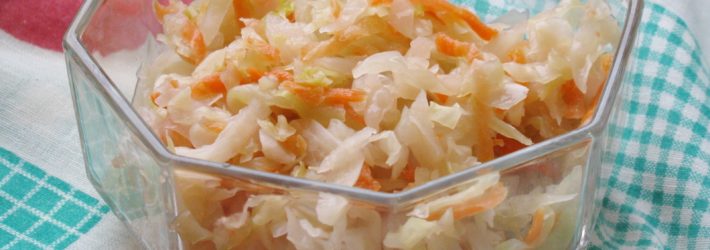
Sauerkraut means sour cabbage. To change cabbage into a tasty, unique condiment, it takes lactic acid fermenting microbes. Fermented foods have been used by traditional cultures for centuries as a means to preserve their fresh foods that would otherwise spoil. Now, we are seeing an increased interest in fermented foods like sauerkraut, due to the important health properties fermented vegetables provide. I have experimented with fermented vegetables for a couple of years now. After losing several ferments to mold contamination, I have learned that they need to be fermented in an anaerobic vessel that allows the CO2 to escape. In addition, it is important to make sure that the vegetables are completely submerged below the brine. I use a Pickl-It for all of my ferments. They are inexpensive and once you purchase a few jars, you will use them over and over again. You can purchase Pickl-It fermentation jars at this website: Pickl-It Disclaimer: I am not affiliated with the Pikcl-It company, just a satisfied customer. One-3 liter Pick-It holds about 5 pounds of shredded cabbage What you will need:
- 2 heads (should be about 5 pounds of shredded cabbage)
- 2 Tbsp Himalayan sea salt (approximately 22 grams)
- 1 Tbsp caraway seeds if desired
Note: you really need a scale for this recipe because it is important that your brine be a 2% salt concentration; therefore, weighing your salt and cabbage is important to reach this concentration.
Directions: 1.Remove any wilted outer leaves from the cabbage. Cut the cabbage in half and then in quarters, remove the core

3. Shred or slice the cabbage to the equivalent of thin ribbons. I use a mandolin slicer, but a knife will do 
4. In a large bowl, toss the cabbage with the sea salt and caraway seeds (if using).
5. After 5 minutes or so, your cabbage will have created its own brine.
6. Place the cabbage and the brine in a fermentation vessel (like a Pickl-It) and press firmly with a wooden spoon. This will eliminate air pockets. If you don’t have enough brine, that is OK, just wait a little longer, it will come. If you still don’t have enough brine, then follow this recipe from the Pick-It website: “To make a 2% percent brine use 1 1/2 T unrefined high-quality sea salt per quart of water.”
7. Or, you can visit the brine calculator at the Pickl-It website. I like to put a single layer of carrots strips over the shredded cabbage, kind of like a lattice (so the CO2 can escape), then press it down again, in order to keep stray shreds of cabbage from floating to the top of the brine. The Pickl-It website has great pictures outlining how to do this: Sauerkraut Photo Essay
8. You should have at least 1 inch of brine covering your cabbage. It is helpful to place a weight on top of the cabbage to keep it submerged, like the DUNK-R from Pickl-It or a small glass jar. See the Sauerkraut Photo Essay.
9. Seal the lid and put water in your air-lock and place it in the Pickl-It top.

10. Cover the jar (but not the airlock) and leave the cabbage on the counter to ferment at room temperature for 10 days. Transfer the cabbage (in the Pickl-It with the airlock) to the refrigerator for 10-12 weeks. By then, you should have a nice, tasty sauerkraut. Note: If you have any kind of digestive disorders, go slowly when eating any type of fermented foods. It may take some time for your digestive system to adjust.


